
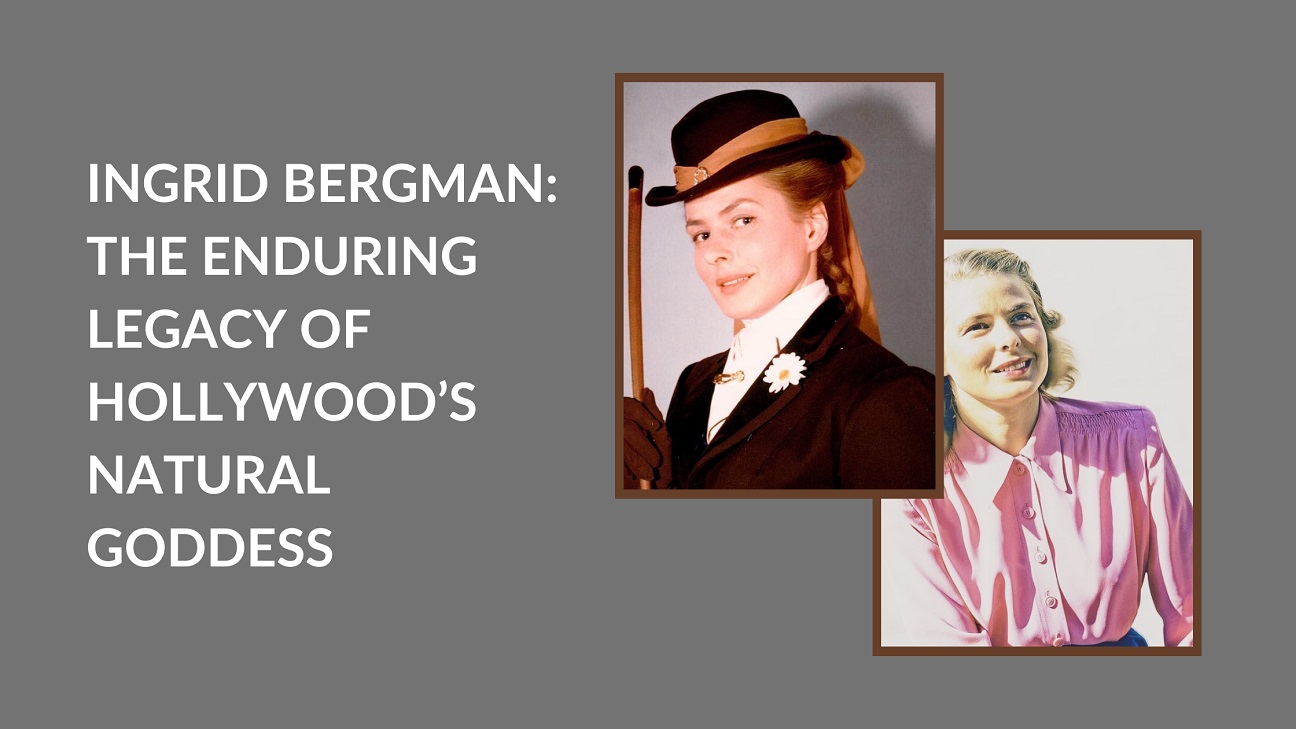
Quick Facts
| Attribute | Details |
|---|---|
| Full Name | Ingrid Bergman |
| Date of Birth | August 29, 1915 |
| Date of Death | August 29, 1982 (aged 67) |
| Height | 5’9″ (1.75 m) |
| Weight | Approximately 135 lbs (61 kg) during her prime (varied with roles and life stages) |
| Nationality | Swedish |
| Profession | Actress (film, theater, television) |
| Estimated Net Worth | $6 million at the time of her death (equivalent to about $20 million today) |
Introduction: Why Ingrid Bergman Remains Famous
Ingrid Bergman stands as one of the most celebrated actresses in the history of cinema, a Swedish star whose natural beauty, luminous presence, and profound acting talent captivated audiences across continents for five decades. Famous worldwide for her iconic role as Ilsa Lund in the timeless classic Casablanca (1942) opposite Humphrey Bogart, Bergman embodied sincerity, strength, and emotional depth on screen. Her career, marked by bold choices, international acclaim, and personal resilience, made her a symbol of authentic womanhood in an era of manufactured Hollywood glamour.
Bergman won three Academy Awards, two Primetime Emmy Awards, a Tony Award, and numerous other honors, achieving the Triple Crown of Acting. Her willingness to take on complex roles—from wartime heroines to tormented characters—cemented her legacy. Even decades after her passing, Ingrid Bergman continues to inspire actors and film lovers, representing a bridge between European art cinema and Hollywood’s Golden Age.
Early Life and Family Background
Ingrid Bergman was born on August 29, 1915, in Stockholm, Sweden, to Justus Samuel Bergman, a Swedish photographer and artist, and Frieda “Friedel” Henriette Auguste Louise Adler, who was German-born. She was named after Princess Ingrid of Sweden. Tragically, her mother died when Ingrid was just two and a half years old, leaving her father to raise her with the help of relatives. Two older siblings had died in infancy before her birth, making her an only child in a household touched by loss.
Her father, a loving and creative influence, encouraged her artistic inclinations, often photographing her. Summers spent in Germany helped her become fluent in German alongside her native Swedish. However, more sorrow followed: her father passed away from stomach cancer when she was 13. Raised thereafter by aunts and uncles, young Ingrid found solace in dreams of performing. These early experiences of loss fostered a deep inner strength and independence that would define her life and career.
Education
Bergman attended the Lyceum School for Girls in Stockholm and began appearing as an extra in films while still a student. Against some family expectations, she pursued acting seriously and gained admission to the prestigious Royal Dramatic Theatre School in Stockholm. There, she studied under director Gustaf Molander, who became a key mentor. Her training emphasized naturalistic performance, which became her signature style. She left the school early after securing film roles but carried its principles throughout her career.
Career Journey: From Swedish Roots to Global Stardom
Ingrid Bergman’s career began in Sweden in the mid-1930s. Her first credited role was in Munkbrogreven (1935). She quickly rose in Swedish cinema with films like the original Intermezzo (1936) and A Woman’s Face (1938), showcasing her natural acting prowess.
Her breakthrough into international fame came with the Hollywood remake of Intermezzo (1939), produced by David O. Selznick. Despite initial studio concerns about her height, accent, and “unconventional” looks, her authentic charm won over audiences and producers. She refused significant changes to her appearance, preserving her natural eyebrows and fresh look.
The 1940s marked her Hollywood golden period. Casablanca (1942) made her a household name, with her portrayal of the conflicted Ilsa Lund delivering one of cinema’s most memorable performances. Other highlights included For Whom the Bell Tolls (1943), Gaslight (1944)—for which she won her first Oscar for Best Actress—The Bells of St. Mary’s (1945), and collaborations with Alfred Hitchcock in Spellbound (1945), Notorious (1946), and Under Capricorn (1949). She earned multiple Academy Award nominations during this prolific decade.
A major turning point came in 1950 when Bergman began a relationship with Italian director Roberto Rossellini while filming Stromboli. The ensuing scandal—due to her pregnancy before divorce from her first husband—led to a temporary exile from Hollywood. She worked in Europe, starring in acclaimed films like Europa ’51 (1952) and Journey to Italy (1954), which are now regarded as neorealist masterpieces.
Her triumphant return to Hollywood came with Anastasia (1956), earning her a second Oscar. Later successes included Indiscreet (1958), Cactus Flower (1969), Murder on the Orient Express (1974)—winning her third Oscar as Best Supporting Actress—and Autumn Sonata (1978), directed by Ingmar Bergman (no relation), which brought another Best Actress nomination. She also excelled on stage and television, winning Emmys for The Turn of the Screw (1960) and A Woman Called Golda (1982).
Throughout, Ingrid Bergman demonstrated versatility, moving fluidly between languages (Swedish, English, German, Italian, French) and styles, from romantic leads to dramatic powerhouses.
Personal Life, Lifestyle, and Family
Ingrid Bergman married three times. Her first marriage was to Swedish dentist Petter Lindström in 1937; they had a daughter, Pia Lindström (born 1938), before divorcing amid the Rossellini scandal. With Rossellini, she had three children: twin daughters Isabella and Ingrid Rossellini (born 1952), and son Roberto (born 1950). She married theater producer Lars Schmidt in 1958; that marriage ended in divorce in 1975.
Despite the scandals, Bergman prioritized her family and work. She lived a relatively private life, valuing independence and authenticity. Her lifestyle reflected her European roots—elegant yet down-to-earth. Known for her luminous beauty, light brown hair, blue eyes, and tall stature, she maintained a natural fitness through an active life rather than rigorous regimens common today. Her height made her stand out, often requiring adjustments in scenes with shorter leading men.
Later in life, she faced breast cancer with characteristic grace, continuing to work until the end.
Net Worth and Income Sources
At the time of her death in 1982, Ingrid Bergman’s estate was valued at approximately $6 million, equivalent to about $20 million in today’s dollars. Her wealth came primarily from high-profile film salaries (she was among the top-paid actresses of her era), theater productions, television work, and endorsements. Smart career management and international appeal sustained her earnings across decades.
Interesting Facts About Ingrid Bergman
- She spoke five languages fluently and acted in all of them.
- Bergman was one of the youngest to achieve the Triple Crown of Acting (Oscar, Emmy, Tony).
- She famously resisted Hollywood’s pressure to alter her name or appearance.
- On her 67th birthday, she passed away from breast cancer complications in London.
- Her daughter Isabella Rossellini followed in her footsteps as a successful actress and model.
- She was an avid photographer, influenced by her father.
FAQ
How old was Ingrid Bergman when she died? She was 67 years old, passing on her birthday, August 29, 1982.
What was Ingrid Bergman’s net worth? Approximately $6 million at her death (around $20 million adjusted for inflation).
What are Ingrid Bergman’s most famous works? Casablanca (1942), Gaslight (1944), Notorious (1946), Anastasia (1956), and Murder on the Orient Express (1974).
What is Ingrid Bergman’s personal background? A Swedish actress born in Stockholm, she overcame early family losses to become a global star known for her natural talent and independent spirit.
Conclusion: Enduring Impact and Legacy
Ingrid Bergman’s impact on cinema is immeasurable. She brought a rare authenticity and emotional intelligence to the screen, challenging stereotypes and elevating the art of acting. From the romantic tension of Casablanca to the introspective depths of her later European films, she left an indelible mark. Her life story—of talent, scandal, redemption, and resilience—continues to fascinate. Though she is no longer with us, Ingrid Bergman’s legacy endures through her films, inspiring new generations to value sincerity and courage both on and off screen. Her future “prospects” live on in the timeless appeal of her work.